General information
Aims of a thesis
Bachelor's and Master's theses in the "Rehabilitation Sciences with a Focus on Learning" department (headed by Prof. Dr Michael Grosche) are written exclusively in the context of current, international and empirical special educational research. In principle, your thesis demonstrates that you can (a) work independently on a precise scientific question (b) using scientific methods (c).
What do you need to pay attention to in your thesis?
- Research question: Formulating and answering a scientific research question is the centrepiece of every Bachelor's or Master's thesis. Developing a research question is a process that often takes many weeks. However, this process is very important, as all further steps of your thesis arise from the research question. The research question must be derived conclusively from theory and previous empirical results. A coherent research design is then developed from the research question. At the end of your thesis, you will answer the research question on the basis of your results.
- Requirements: Bachelor's and Master's theses must comply with the principles of scientific work, be theory-based, incorporate current empirical findings, derive relevant questions, demonstrate your own argumentation, establish overarching connections and include a well-founded theoretical and methodological reflection.
- Literature: For your thesis, you will mainly read, edit and cite research articles from German and English-language peer-reviewed journals. Bachelor's and Master's theses must be based on your own database-supported literature research (in particular current original empirical work from peer-reviewed journals). International literature must also be included.
- Methodology: We basically distinguish between three methods in which you can write your thesis at our department. You will either carry out a quantitative-empirical study, a qualitative-empirical study or a systematic theory-based literature review(assessment criteria). Good knowledge of quantitative and/or qualitative research methods or in relation to systematic literature reviews is essential. Experience with appropriate software (e.g. EXCEL, JASP, SPSS, PSPP, R or MAXQDA) and scientific literature databases or the willingness to familiarise oneself independently are required.
- Topics: The content of your Bachelor's or Master's thesis will normally be based on the following projects. However, we are also open to other topics and questions that you would like to contribute.
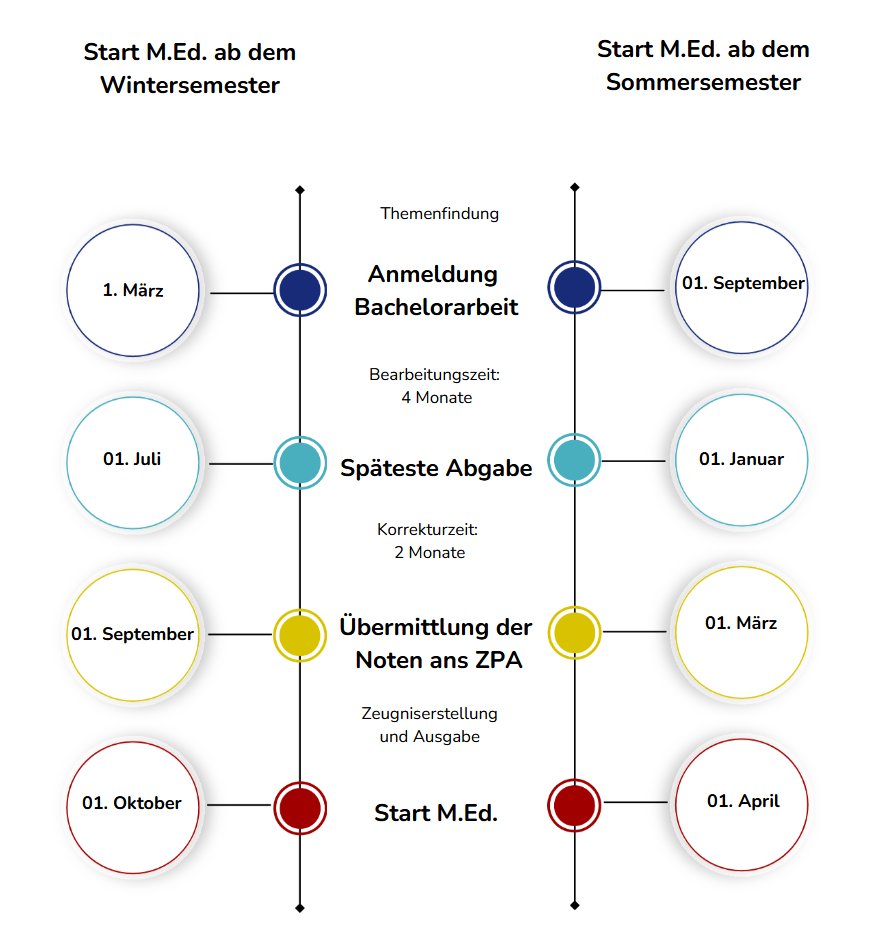
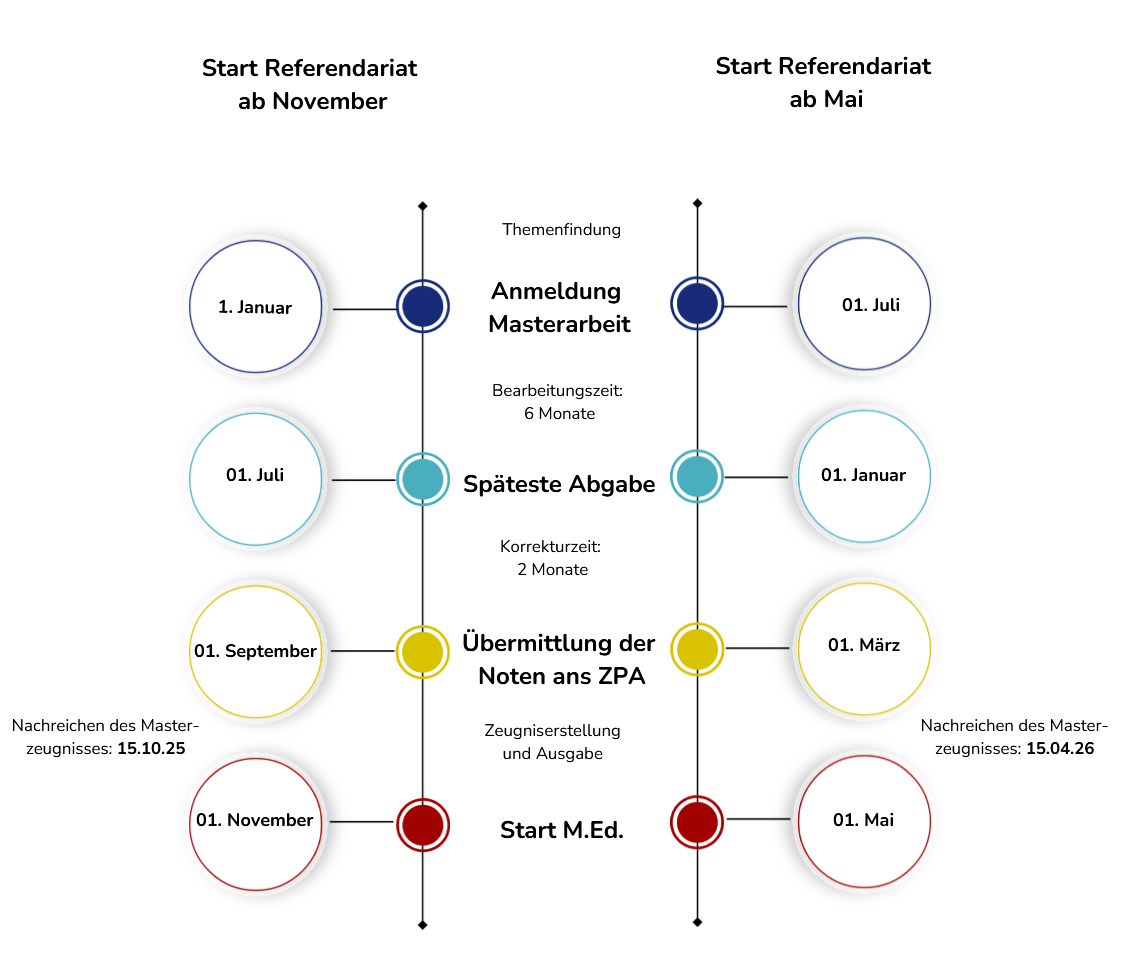
- Timetable: In principle, you can start your thesis at any time. However, if you are about to move on to a Master's degree or a traineeship (Referendariat), you should adhere to the following timetable. If your grade has to be entered by September of a given year, you should register your thesis with the Central Examination Office (ZPA) as early as mid-January. If your grade must be registered by March, you should register your thesis with the ZPA by mid-July of the previous year. However, you must of course have already discussed your topic with us beforehand. You must therefore contact us a good year before the change. You can find a tabular overview of the timetables for the Bachelor's thesis and the preparatory service for the Special Education degree programme here:
Please always discuss the basic thematic focus of your thesis with us at an early stage and use this discussion to clarify whether we are generally suitable for you as a topic. Even if your thesis still seems a long way off, it makes sense to get in touch with us 12 to 18 months before the topic is set. Please note the following requirements:
- You are planning to work on a question in your Bachelor's or Master's thesis that is linked to a project of the working group in terms of content or is orientated towards one of the topics listed below.
- It is recommended that you have studied at least one course with the relevant supervisor.
- You must be able to research in scientific databases and understand English-language literature.
- The textbook by Peters and Dörfler (2019a) is particularly suitable for your initial considerations on the structure of the thesis. At the beginning of your considerations, you must have already worked on at least chapters 1 (Finding a topic...), 2 (Workload...) and 3 (Procedure...) from this book.
- Before the first personal appointment to discuss your Bachelor's or Master's thesis, you should have already carried out some initial literature research and at least familiarised yourself with the topic of interest. You must therefore bring a bibliography with at least three current original empirical papers exclusively from peer-reviewed journals that you have studied. English-language literature should also be included.
Formal requirements for your thesis
The textbook by Peters and Dörfler(2019b) forms the basis for the formal design of your thesis. All formal questions (e.g. on scope, design, structure and citation) are answered there. In any case, please formulate an abstract in German; an abstract in English is optional (see Peters & Dörfler, 2019b). We rate the form of your work as very good if you have correctly implemented the aspects described in this book. The only deviation from the formalities mentioned in Peters and Dörfler(2019b) can be found in the next point (length of the thesis).
Recommendations for the length of the thesis
Your Bachelor's thesis should be approximately 30 to 40 pages long (maximum 60 pages). Your Master's thesis should be approximately 40 to 60 pages long (maximum 80 pages).
Assessment criteria for your thesis
At our department, we distinguish between the following three methodological approaches for your thesis. You can download the respective assessment criteria and information on grading.